Ranking higher in Google: what really works in 2026?

Almost every business owner wants to rank higher in Google, but the web is full of contradictory advice and quick tricks. In this blog we line up what really works in 2026 to rank higher, and what is wasted effort. Practical and without promises no one can deliver.
Ranking higher in Google is not a matter of luck or a secret trick. It is the result of doing a number of things well and keeping at it. The good news: the basics are understandable for everyone, even without a technical background.
What really works in 2026 differs from what helped five years ago. Google has become smarter and increasingly looks at what the visitor genuinely gains from a page. Many old pieces of advice no longer hold as a result. In this blog we separate what works from what is wasted effort.
This blog belongs to our pillar SEO in Groningen, in which we explain local visibility. Here we look more broadly at what determines your rankings and how you improve them.
How do I rank higher in Google without paying for ads?
There are two ways to appear in Google: paid through ads, and organic through search engine optimisation. Ads stop the moment you pay; organic positions remain.
Ranking higher without ads means investing in SEO. That costs time instead of a click budget, but the result is more durable. You build a position that keeps working for you, even if you do nothing for a while.
For most local business owners, organic visibility is the smartest investment. You do not pay per visitor and you build something lasting.
Which factors determine your position in 2026?
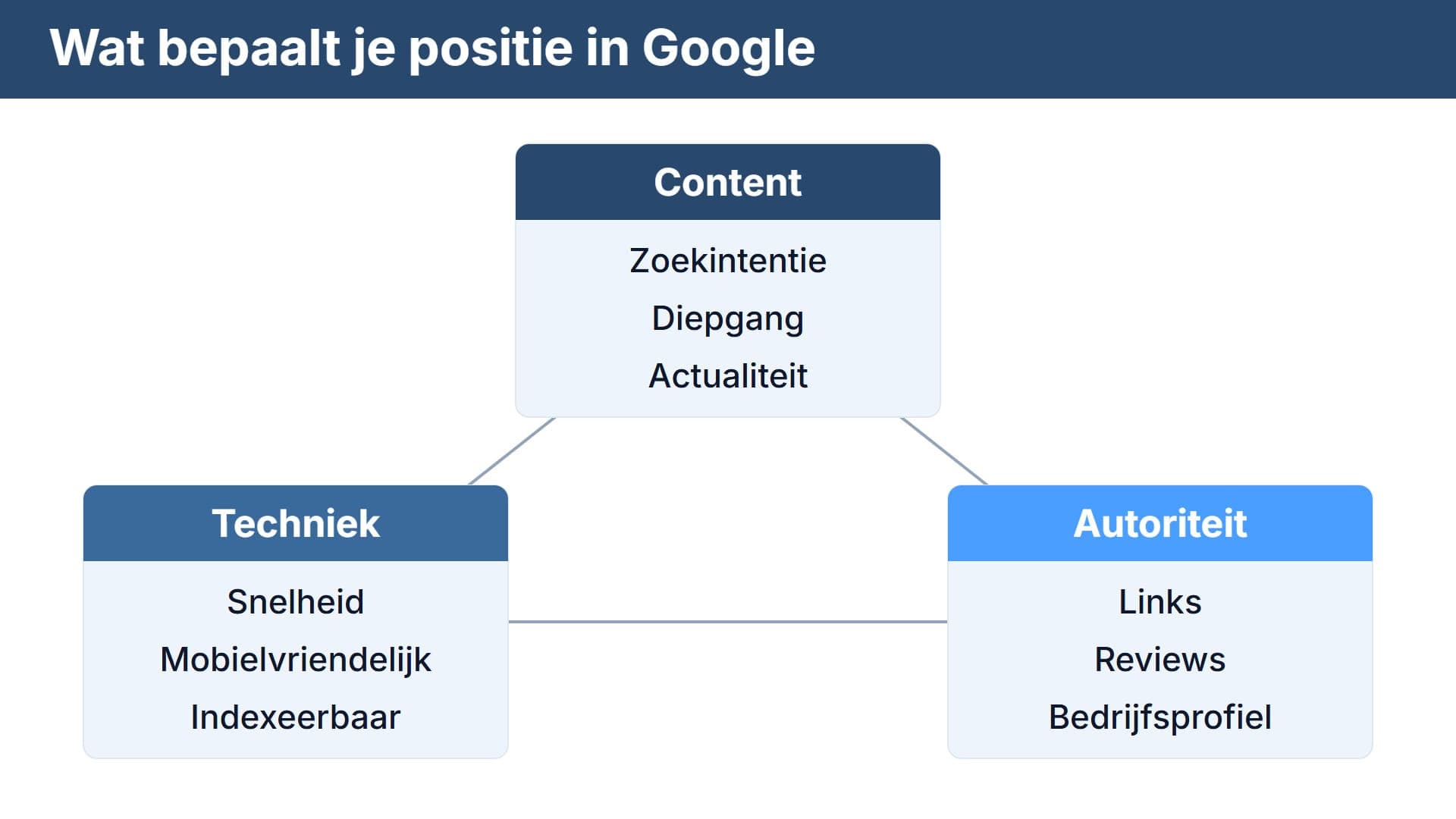
Google uses hundreds of signals, but in practice it comes down to a number of core areas.
- Relevant, good content: pages that really answer the searcher's question.
- Technology and speed: a site that loads fast and works well on mobile.
- User experience: visitors easily find what they are looking for and stay.
- Authority: other sites and sources refer to you.
- Local signals: your Google Business Profile, reviews and consistent details.
The common thread in 2026 is clear: Google rewards websites that are genuinely useful for the visitor. Tricks to outsmart the system work less and less. Whoever puts their visitor first wins in the long term.
Start with good content
Content is still the basis of ranking higher. But it is not about as much text as possible, it is about the right text.
Good content:
- answers a concrete question from your audience
- is clearly written, without unnecessary jargon
- covers the topic completely
- is built with clear headings
- matches how people really search
Think from your customer: which questions do they have before they get in touch? Every well-answered question is an opportunity to be found. A page that really solves a question almost always does better than a thin text full of keywords.
It helps to think in topics, not in separate keywords. Cover a theme completely: explain, give examples, answer the follow-up questions. That way you become a reliable source on that topic for Google, and that strengthens your whole website. A few thorough, complete pages deliver more than dozens of superficial ones. Quality and completeness win over quantity in the long term.
Make sure your technology and speed are right
You can have the best content, but if your site is slow or works poorly on mobile, you will not rank high. Speed is a direct ranking factor and determines whether visitors stay.
Pay attention to, among other things:
- the load time, especially on mobile
- large, uncompressed images
- unnecessary scripts and plug-ins
- a logical, tidy structure
A faster site often gives you an immediate advantage over slower competitors. In our blog about a faster website you read exactly how to tackle this. It is one of the most underestimated ways to rise.
Do not forget the mobile side either. The majority of searches nowadays happen on a phone. Google therefore judges your site mainly on how it works on mobile. A website that looks fine on a computer but is slow or messy on a phone misses a lot of traffic as a result. Always test your most important pages on a phone, not only on your own screen.
Difference between on-page and off-page SEO
SEO roughly splits into two parts, and you need both.
- On-page SEO is everything on your own website: your content, titles, headings, internal links, technology and speed. You have full control over this.
- Off-page SEO is everything outside it: links from other websites, mentions, reviews and your general online reputation. You build this indirectly.
For most business owners the biggest, fastest gain lies in on-page SEO. That is in your own hands. Off-page you then build up gradually, by delivering good work that people want to refer to.
Many business owners make the mistake of wanting to score with links and off-page tactics straight away, while their own pages are not yet in order. That is like advertising for a shop that is not open yet. So start inside, with your own website, and only look outward after that. A strong foundation makes every next step more effective.
Work on your authority and trust
Google wants to send visitors to reliable sources. Building authority means showing that you know what you are talking about and that others trust you.
You do that, among other things, by:
- collecting reviews from satisfied customers
- being mentioned on relevant, reliable websites
- making valuable content that gets referred to
- keeping your details consistent everywhere
For local businesses, reviews and a completed Google Business Profile carry extra weight. They strengthen both your position and the trust of whoever finds you. Authority grows slowly, but it is one of the most lasting advantages.
Do not chase quick tricks to buy authority. Bought links from dubious sites do not help and can even harm you. It works better to simply deliver good work and be visible about it: a satisfied customer who recommends you, a mention in a local news item, a collaboration with another business owner. Those natural signals build a reputation that genuinely lasts.
How long does it take to rank higher in Google?
This is where many business owners get impatient. SEO is not a sprint. The first effects of improvements can be visible within a few weeks, but really rising for competitive terms usually takes several months.
You often see clear movement between three and six months, and after that it builds up further. The more competitive your market, the longer it takes.
That sounds slow, but consider: every position you win keeps working for you. Unlike ads, it does not stop the moment you no longer pay. Patience and consistency are your biggest allies here.
Do not forget the local signals
For a local business, not only your website and links determine your position, but also your local signals. These can make the difference in the local results and the map block.
The most important local signals are:
- a fully completed Google Business Profile
- consistent business details everywhere on the web
- recent, genuine reviews from customers
- mentions on relevant local and industry websites
Many business owners focus on their website and forget this low-hanging gain. While a good profile with strong reviews often makes you visible faster than months of tinkering with your website alone. For local search, these signals and your website work strongest together.

Why does my website sometimes drop in the rankings?
A drop is annoying, but rarely random. There is usually an explainable cause behind it.
Common reasons:
- competitors improve their website and overtake you
- Google adjusts its assessment with an update
- your content has become outdated and less relevant
- technical problems, such as a slower site or errors
- you have not done anything about your SEO for a while
The solution is almost always the same: keep your website current, fast and relevant. Whoever stands still slips away by itself because others keep going. SEO is therefore not a one-off job.
Avoid the tricks that no longer work
Many old SEO tactics do more harm than good. They cost you time or even your position.
Stay away from:
- stuffing pages with keywords
- thin location pages without real content
- bought, irrelevant links
- copied or machine-generated texts without value
- promises of a guaranteed first place
The common thread: anything meant to mislead Google instead of helping the visitor works increasingly poorly. Focus on real quality, then you are working in a future-proof way.
The temptation of a quick fix is great, especially when results are slow. But the time of tricks is over. Google gets better every year at recognising artificial tactics, and a penalty costs you more than you ever win with a trick. Rather invest that energy in things that work lastingly: good content, a fast site and satisfied customers who recommend you.
Want to rank higher in Google structurally? We help you with content, technology and an approach that suits your business and region. See our SEO service or get in touch for a picture of what can be improved in your visibility.
Frequently asked questions
How do I rank higher in Google without paying for ads?
By investing in SEO: good content, a fast and technically healthy website, a strong user experience and authority through reviews and mentions. It costs time instead of a click budget, but the result is more durable than ads.
Which factors determine my Google position in 2026?
The core areas are relevant content, technology and speed, user experience, authority and local signals such as your Google Business Profile and reviews. The common thread in 2026 is that Google rewards websites that are genuinely useful for the visitor.
How long does it take to rank higher in Google?
First effects can be visible within a few weeks, but really rising for competitive terms usually takes three to six months, after which it builds up. The more competitive your market, the longer it takes. Every position you win then keeps working for you.
What is the difference between on-page and off-page SEO?
On-page SEO is everything on your own website: content, titles, headings, internal links, technology and speed. Off-page SEO is everything outside it, such as links from other sites, mentions and reviews. The biggest, fastest gain usually lies in on-page SEO.
Does website speed help to rank higher?
Yes, speed is a direct ranking factor and determines whether visitors stay. A faster site often gives you an immediate advantage over slower competitors, especially on mobile. It is one of the most underestimated ways to rise.
Why does my website sometimes drop in the rankings?
Usually because competitors overtake you, Google adjusts its assessment, your content is outdated or there are technical problems. The solution is almost always: keep your website current, fast and relevant. Whoever stands still slips away by itself.