Shopify vs WooCommerce: which to choose for your webshop

Anyone who wants to start a webshop quickly arrives at two names: Shopify and WooCommerce. They are the two most popular platforms, but they work very differently. One is an off-the-shelf package, the other an extension of WordPress. Which suits you best? In this article we compare both, without preference, so you make a choice that fits your situation.
The choice between Shopify and WooCommerce is one of the first important decisions when setting up a webshop. It is also a choice that is hard to reverse. Switching later costs time and money, so it pays to think it through in advance.
In this article we explain how both platforms work, where they differ and who they suit. We do not name a winner, because there is none: it depends on your situation. If you want to look more broadly at the choice between off-the-shelf and custom, also read our article on WordPress, Shopify or custom. Looking for the whole picture from start to launch, then read our complete guide to having a webshop built.
What is Shopify?
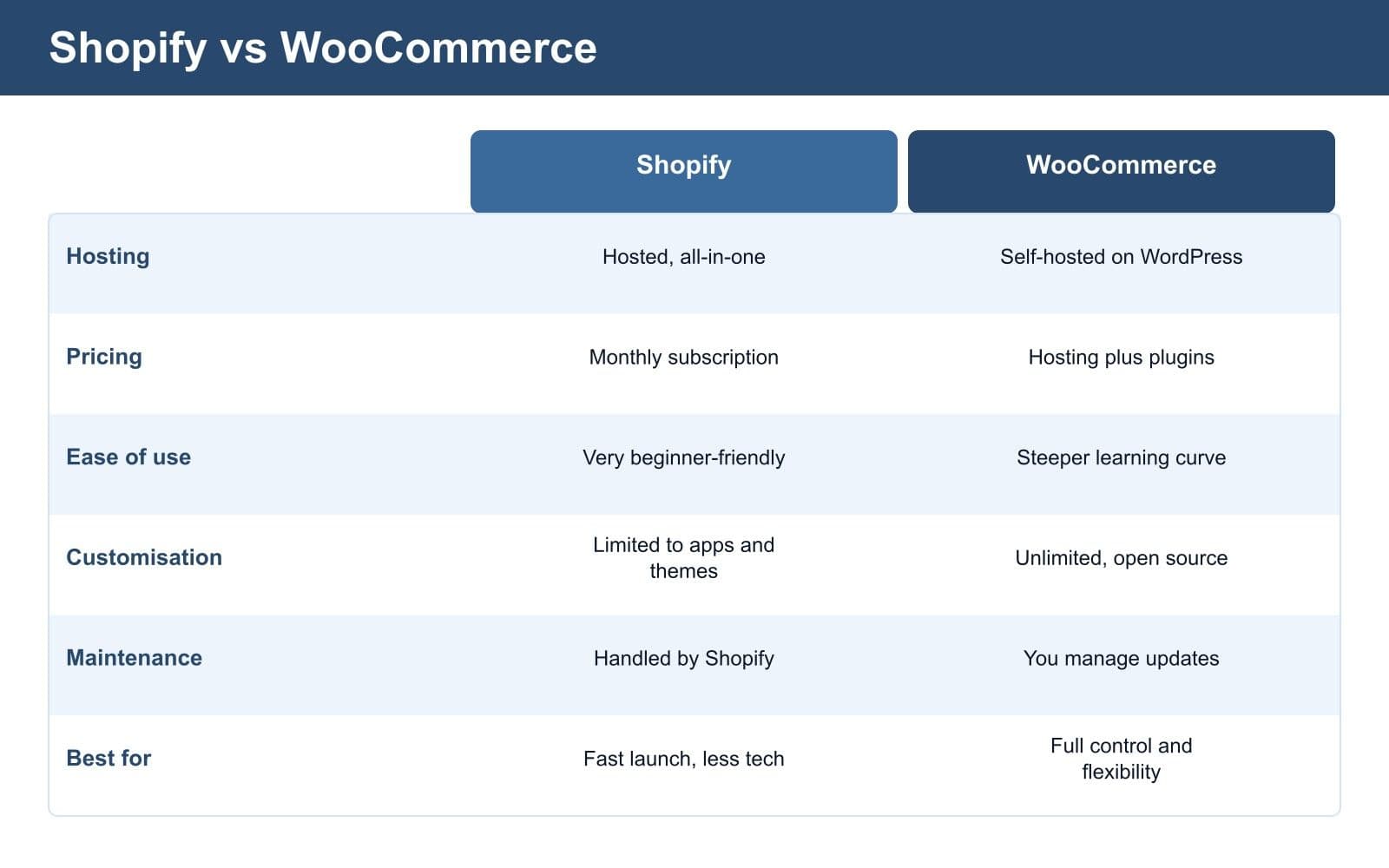
Shopify is an off-the-shelf webshop platform. You pay a fixed amount per month and get everything you need to sell: hosting, security, payments and updates are taken care of.
Shopify's great strength is ease. You do not have to think about technology. You set up your shop, add products and start selling. Updates and security happen in the background.
The downside is less freedom. You work within the possibilities Shopify offers. For special requirements you depend on apps, which often cost a monthly amount of their own. And you keep paying, even when you sell less for a while.
What is WooCommerce?
WooCommerce is not a standalone platform, but an extension of WordPress. You start with a WordPress website and turn it into a webshop with WooCommerce. The software itself is free, but you arrange hosting, security and maintenance yourself.
WooCommerce's strength is freedom. Because it runs on WordPress, you can adjust almost everything. There are countless extensions, and you own your own environment.
The downside is responsibility. Updates, security and backups are your task, or that of the party you hire. WooCommerce therefore asks for more technical care than Shopify. In return, you are not tied to a fixed monthly price from the platform itself.
Costs compared
Costs are often decisive, but they work differently than many people think. It is not only about the monthly price.
With Shopify you pay (indicative):
- a fixed monthly amount for the platform
- transaction fees per sale
- extra costs for some apps
With WooCommerce you pay (indicative):
- hosting (monthly or yearly)
- paid extensions if needed
- maintenance, yourself or outsourced
- transaction fees from your payment service
Shopify is more predictable: you know what you spend each month. WooCommerce can work out cheaper, but only if you can do the maintenance yourself. Calculate it for your situation, because the real costs often sit in maintenance and time, not in the purchase.
Ease of use and maintenance
This is where the biggest difference between the two lies. Shopify takes the technical work off your hands. WooCommerce gives you control, but puts the responsibility with you.
Shopify is suitable if you:
- want to start quickly without technical worries
- have no time or appetite for maintenance
- want predictable costs
WooCommerce is suitable if you:
- want maximum freedom
- already work with WordPress
- can do maintenance yourself or have it done
Many business owners underestimate the maintenance with WooCommerce. Updates and security are not a one-off job, but ongoing work. If you do not do it, you risk problems. That is why many WooCommerce shops outsource the maintenance.
So the question to ask yourself is not only which platform looks best, but how much time and attention you want to put into it yourself. If you have no technical background and want to focus fully on selling, the ease of Shopify weighs heavily. If you actually enjoy keeping control and setting everything up as you like, WooCommerce suits how you work better.
Visibility and SEO
A frequently asked question is which platform scores better in Google. The answer: both can perform well. SEO depends much more on your content, speed and structure than on the platform itself.
WooCommerce has the advantage that it runs on WordPress, which has traditionally been strong in content and blogs. You have a lot of control over technical SEO details.
Shopify is technically tidily built and fast, but gives you slightly less control over certain details. For most webshops that is not a problem.
In short: do not choose on SEO alone. A well-maintained shop on either platform can be found just fine. The content and the maintenance make the difference, not the name of the platform.
Growth and expanding in the long run
Your webshop of today is not your webshop in three years. Growth brings new demands: more products, more visitors, integrations with other systems. How do both platforms handle that?
Shopify grows with you within its own frameworks. You can scale up to more expensive plans with more possibilities, and there are apps for almost everything. The limit is in custom work: very specific requirements do not always fit.
WooCommerce grows with you as long as your hosting and maintenance grow too. Because you can adjust everything, you run into limits less quickly. But a busy shop asks for heavier hosting and more technical attention.
So think ahead. Do you expect integrations with your bookkeeping, stock system or point of sale? Then ask in advance whether the platform can handle that. A choice that seems easy now can pinch later if you grow fast.
When do you choose Shopify?
Shopify is often the right choice if ease and speed weigh more heavily than full freedom. It suits business owners who want to sell, not tinker.
Consider Shopify if:
- you want to go live quickly without technical knowledge
- you do not want to put time into maintenance
- you find predictable monthly costs pleasant
- you sell standard products without special requirements
- you want to sell internationally with multiple currencies
For many starting and growing webshops, Shopify is a safe, comfortable choice. You pay for ease, and for many business owners that ease is worth the money.
When do you choose WooCommerce?
WooCommerce suits you better if you value freedom and control, and are willing to arrange or outsource maintenance.
Consider WooCommerce if:
- you already have a WordPress website
- you want to be able to adjust a lot
- you have special requirements or integrations
- you do not want fixed platform costs
- you put content and blogs central
WooCommerce gives you more room to make your shop exactly as you want. But that freedom comes with responsibility. Without good maintenance a WooCommerce shop becomes vulnerable. So make sure you can do this well yourself or have it arranged.
Can you switch later?
Switching from one platform to the other is possible, but it is not a small job. Products, customers and orders have to be transferred, and you often rebuild your design.
That is why the first choice is important. Still, you do not have to be afraid of being stuck forever. If your shop outgrows your platform, switching is possible. Just plan it well and count on time and costs.
The best advice: do not choose for now, but for where you want to be in two years. That way you prevent an expensive switch at the moment you are actually busy growing.
With a switch, also watch your visibility. If you are not careful about redirecting old web addresses to the new ones, you can temporarily lose positions in Google. Good preparation prevents a technical switch from also costing you visitors. So get advice before you make the decision.
Is custom an alternative?
Shopify and WooCommerce are not the only options. For webshops with special processes, integrations with other systems or a unique business model, custom can be the better choice.
Custom means a webshop built entirely around your way of working. That costs more up front, but delivers a shop that does exactly what you need, without the limitations of a standard platform.
For most starting and growing business owners, Shopify or WooCommerce are fine. Custom becomes interesting when you run into the limits of a standard platform. If you doubt what fits, we are happy to help you with having a webshop built on the platform that suits you.
How do you make the decision?
The choice does not have to be complicated if you know what to look at. Ask yourself these questions:
- how much time do I want to put into maintenance?
- how important is full freedom to me?
- do I already work with WordPress?
- do I want predictable costs or lower fixed costs?
- do I have special requirements or integrations?
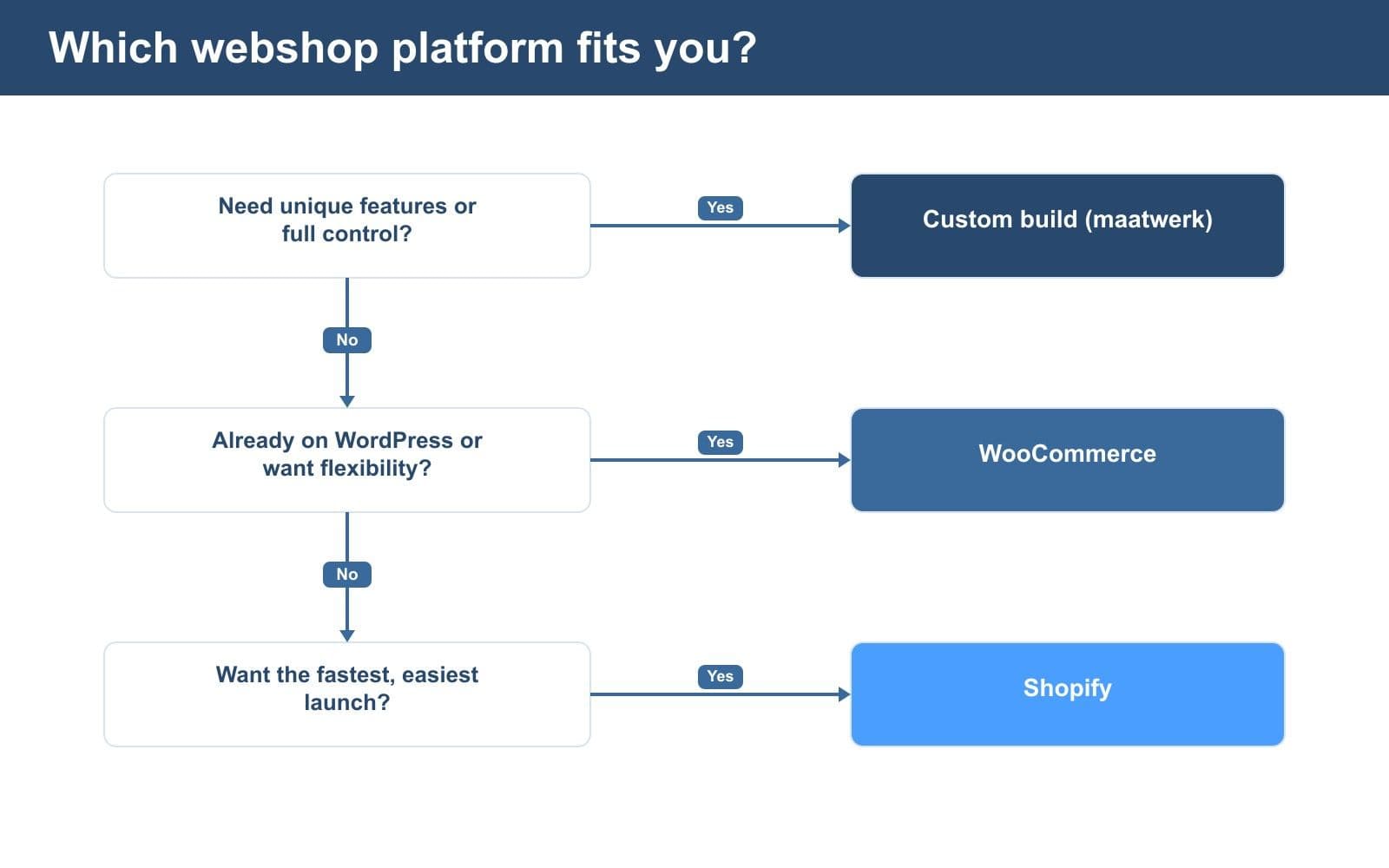
Want ease and speed? Then it leans towards Shopify. Want control and freedom, and can you arrange maintenance? Then WooCommerce suits better. Have special requirements? Then custom is worth considering. There is no wrong answer, only a choice that fits you best.
Still doubting between Shopify, WooCommerce or custom for your webshop? We think along with you based on your products, budget and growth plans, without preference for a platform. That way you choose with confidence. See our webshop options or request no-obligation advice.
Frequently asked questions
What is the difference between Shopify and WooCommerce?
Shopify is an off-the-shelf platform where hosting, security and updates are taken care of for a fixed monthly amount. WooCommerce is a free extension of WordPress where you arrange hosting and maintenance yourself, but have more freedom. Shopify is about ease, WooCommerce about control.
Which platform is cheaper in the long run?
That depends on your situation. Shopify has predictable monthly costs. WooCommerce can be cheaper if you do the maintenance yourself, but more expensive if you outsource it. Always calculate the total costs, including maintenance and time, not just the monthly price.
Which platform is easier to maintain?
Shopify is easier, because updates and security happen in the background. WooCommerce requires ongoing maintenance that you do yourself or outsource. If you do not want to worry about technology, Shopify is easier.
When do I choose Shopify and when WooCommerce?
Choose Shopify if you want to start quickly, want no technical worries and find predictable costs pleasant. Choose WooCommerce if you already work with WordPress, want to be able to adjust a lot and can do maintenance yourself or have it arranged. The choice depends on your wishes and how much time you want to put into technology.
Can I switch from one to the other later?
Yes, switching is possible, but it is not a small job. Products, customers and orders have to be transferred and you often rebuild the design. That is why it is wise to choose in advance for where you want to be in a few years, so you prevent an expensive switch.
Which platform is better for SEO?
Both can score well in Google. SEO depends much more on your content, speed and structure than on the platform itself. WooCommerce gives slightly more control over details through WordPress, but a well-maintained Shopify shop is found just as well. So do not choose on SEO alone.