SEO for existing websites: what can you improve without a new website?

Many business owners want to be found better in Google, but quickly think that this requires a completely new website. Sometimes that is true. If your website is technically outdated, slow or poorly built, a new website can be the best choice.
But far from always.
In many cases you can already improve a lot with an existing website. By sharpening pages, processing keywords better, optimising metadata, adding internal links and checking technical basics, you can make your website match what your audience is searching for more closely.
SEO for an existing website is therefore not about tricks, but about purposefully improving what is already there.
When is SEO on an existing website worthwhile?
SEO on an existing website is mainly worthwhile if the technical foundation is reasonably good and the website still suits your business.
That means, for example:
- the website works well on mobile
- pages load acceptably fast
- the structure is logical
- the main services already have their own pages
- the website is easy to manage
- there are no major technical errors
- the content is still largely usable
Is that the case? Then you often do not have to start over straight away. You can improve step by step.
SEO becomes harder when the website is strongly outdated technically, works poorly on mobile or is barely manageable. In that case a technical renewal or new website can be wiser.
Start with the most important pages
Many business owners immediately think of blogs when it comes to SEO. But the biggest gain is often not in new blogs, but in existing pages.
Service pages in particular are important. These are often the pages where potential customers decide whether to get in touch.
Think of pages such as:
- having a website built
- website maintenance
- SEO
- having a webshop built
- contact
- local landing pages
- frequently asked questions
- cases or projects
These pages should not only be found well, but also convince. A page that attracts traffic but does not build trust delivers little.
So start with the question: which pages are most important for enquiries or revenue? Those pages deserve attention first.
1. Improve the page titles
The page title is an important part of SEO. It is often the title people see in the search results. A good title makes clear what the page is about and why someone should click.
A weak title is, for example:
- Services
A better title is:
- Having a website built for business owners | IT Comsol
- Outsourcing website maintenance | Management & Growth
A good page title usually contains:
- the most important keyword
- a clear promise or context
- the company name if relevant
- not too many unnecessary words
Do make sure titles stay natural. You are not only writing for Google, but mainly for people who have to decide whether to click through.
2. Write better meta descriptions
A meta description is not a direct guarantee of higher positions, but it can influence how many people click through from Google.
A good meta description briefly summarises what the visitor can expect. Example:
- Have your website maintained by IT Comsol. Choose technical management or monthly growth with SEO, content and conversion improvements.
A good meta description:
- is concrete
- names the problem or benefit
- matches the search intent
- contains the main topic
- invites people to click through
Many websites have missing or generic meta descriptions. That is a relatively simple improvement.

3. Make your heading structure clearer
A clear H1, H2 and H3 structure helps visitors and search engines understand what a page is about.
Every important page ideally has one clear H1. After that you use H2s for main topics and H3s for sub-parts.
A messy structure makes a page less pleasant to read. Especially on longer pages a good heading structure is important.
Example of a clear structure:
- H1: Outsourcing website maintenance
- H2: Why website maintenance is important
- H2: What is included in our maintenance plan?
- H2: Maintenance & Management or Maintenance, Management & Growth?
- H2: Who is website maintenance suitable for?
- H2: Frequently asked questions
This way a visitor quickly sees what is on the page. Google also gets more context about the content.
4. Process keywords in a natural way
SEO does not mean you should repeat a keyword as often as possible. That actually makes texts unnatural and less convincing.
Good SEO starts with understanding what your audience is searching for. Then you process those terms in logical places:
- in the title
- in the H1
- in some H2s
- in the intro
- in the body text
- in alt texts for images
- in internal links
- possibly in FAQs
For a page about website maintenance, relevant terms could be:
- website maintenance
- website management
- outsourcing website maintenance
- WordPress maintenance
- keeping a website secure
- website maintenance Groningen
Use these terms only where they fit logically. The text must stay pleasant to read.
5. Add frequently asked questions
FAQs are strong for SEO and conversion. They answer concrete questions visitors have before they get in touch.
Examples:
- What does website maintenance include?
- How often does a website need maintenance?
- Is website maintenance needed for WordPress?
- What does website maintenance cost?
- Can SEO be done on an existing website too?
- Do I need to have a new website built for better visibility?
FAQs make a page more complete. They also let you respond to long-tail searches: specific questions people literally type into Google.
Do make sure the answers are short, concrete and honest. Avoid long sales pitches in FAQs.
6. Improve internal links
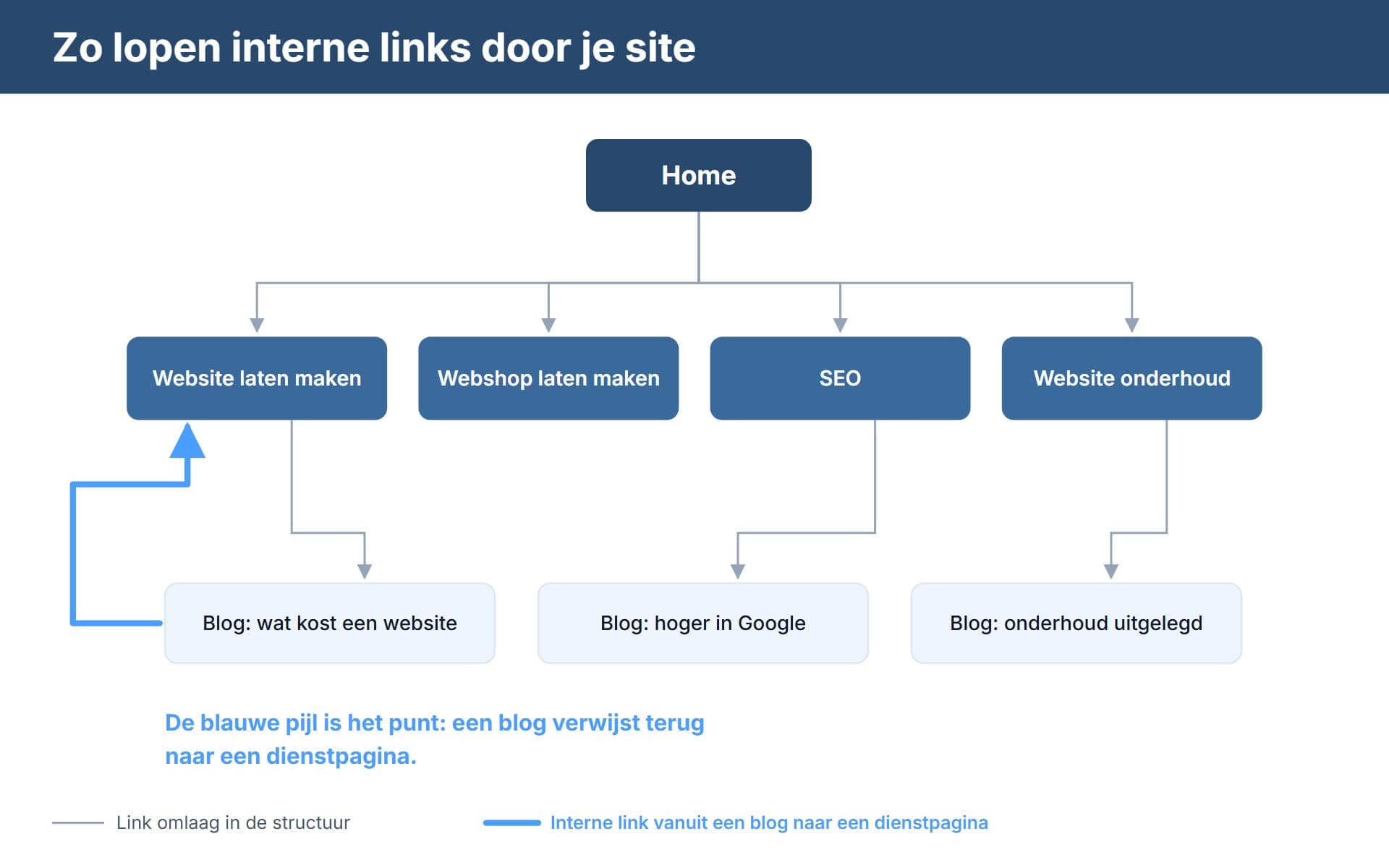
Internal links are links between pages on your own website. They help visitors navigate your website logically and help search engines understand which pages are important.
A blog about website maintenance can, for example, link to the Maintenance & Management service page. A page about having a website built can link to projects or cases. An SEO blog can link to a relevant SEO service page.
Good internal links:
- use clear anchor texts
- link to relevant pages
- support the customer journey
- guide visitors towards contact or services
- prevent valuable pages from being isolated
Not: Click here
Instead: See our options for website maintenance
Internal links are relatively simple to add and can make a big difference in structure and usability.
7. Update outdated content
An existing website often contains texts that were once correct, but have since become less strong.
Think of:
- old services
- outdated prices or pricing logic
- old project examples
- a dated way of working
- blogs with outdated information
- contact information that is no longer correct
- texts that no longer match your current positioning
Outdated content can cost trust. Visitors want to see that your business is active and professional.
So SEO is not only about creating new content, but also about improving and updating existing content.
8. Make pages more specific
General pages are often harder to find and less convincing.
A page with "services" is less strong than separate pages for:
- having a website built
- having a webshop built
- website maintenance
- SEO
- a custom website
- local SEO
- website optimisation
Specific pages match concrete searches better. They also give more room to convince the visitor properly.
That does not mean you have to make a separate page for every small topic. But important services do deserve their own page with clear content, examples, benefits and CTAs.
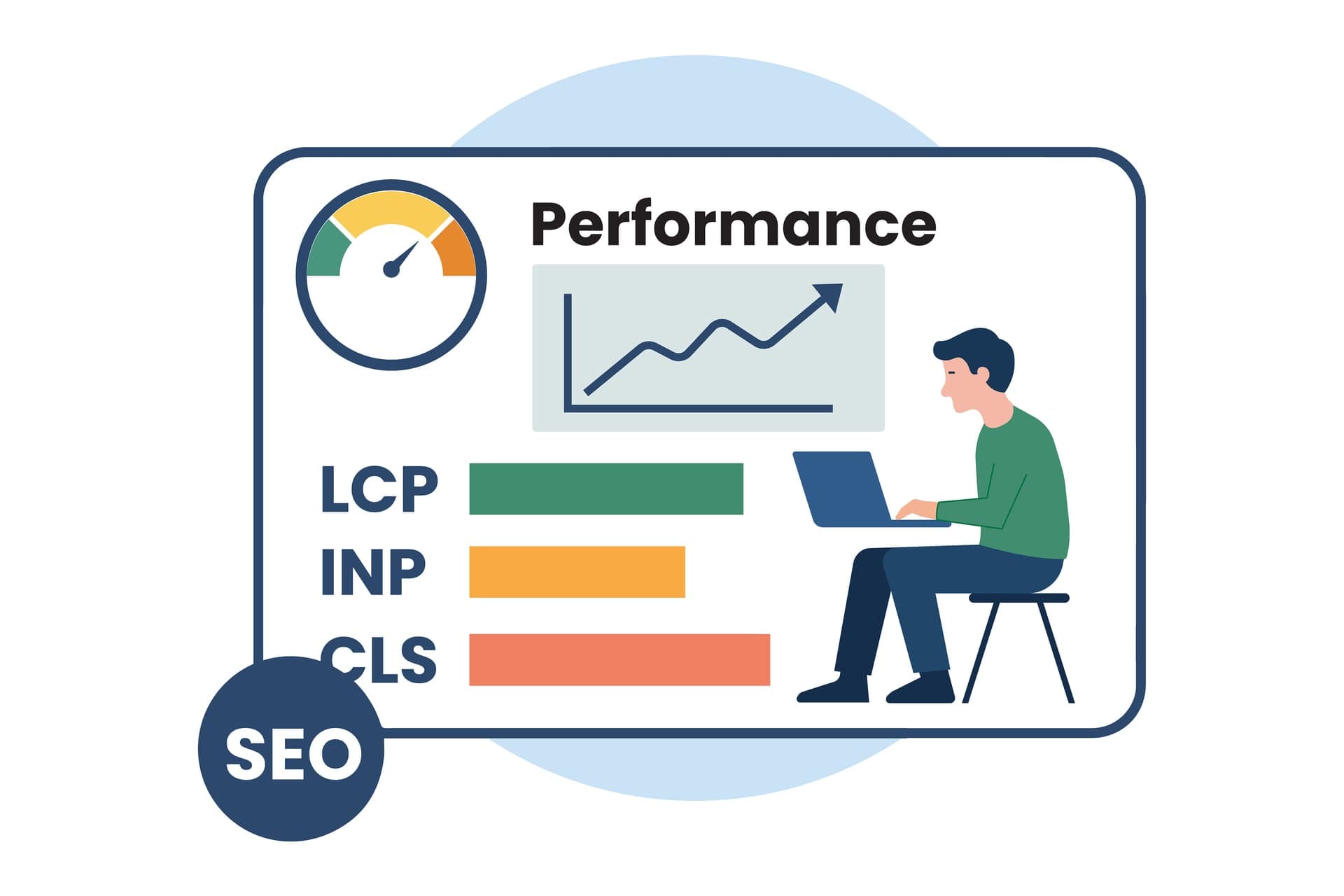
9. Check the speed of your website
Speed is important for the user experience. A slow website causes people to drop off more quickly, especially on mobile.
With SEO for an existing website, speed is therefore an important checkpoint.
Pay attention to, among other things:
- large images
- heavy scripts
- unnecessary plug-ins
- caching
- hosting
- mobile performance
- unnecessary tracking tools
- technical errors
Sometimes small improvements are enough. In other cases the delay sits deeper in the theme, the technology or the hosting.
If a website stays structurally slow, technical modernisation can be wiser than continuing to optimise.
10. Check whether Google can index your pages properly
A page can be written ever so well, but if Google cannot find or index it properly, it delivers little.
So check whether:
- important pages can be indexed
- there are no unintended noindex settings active
- the sitemap is correct
- internal links to important pages are present
- pages do not give technical error messages
- redirects are set up correctly
- old pages do not give 404 errors
These are technical SEO points that are often overlooked, but are important for visibility.
11. Use Google Search Console for opportunities
Google Search Console can give a lot of insight into how your website performs in Google.
You can, for example, see:
- which keywords your website gets impressions for
- which pages are already visible
- where you have many impressions but few clicks
- which keywords are close to page 1
- which pages have technical problems
- whether pages are indexed properly
This helps you improve more purposefully.
Example: a page gets many impressions for "outsourcing website maintenance", but few clicks. Then it can be worthwhile to improve the SEO title and meta description. Is a page ranked between position 8 and 15? Then extra content, a better structure or internal links can help.
Without data you optimise more on gut feeling. With data you can make better choices.
12. Add local SEO where relevant
For local business owners, regional visibility is important. If you are looking for customers in a certain region, your website should make that clear too.
Think of terms such as:
- website maintenance Groningen
- having a website built Groningen
- web design Groningen
- SEO for local business owners
- website management in the North of the Netherlands
Local SEO can be strengthened by:
- processing place names naturally
- a good contact page
- a Google Business Profile
- local cases
- reviews
- regional landing pages where logical
- clear NAP details: name, address and phone number
Note: do not make thin local pages without content. Local SEO works better when the pages are genuinely relevant.
13. Improve conversion alongside SEO
More visitors are valuable, but only if your website also helps visitors take action.
SEO and conversion therefore go together.
Pay attention to:
- clear calls to action
- contact buttons in logical places
- clear service pages
- trust through cases or reviews
- short forms
- clear benefits
- an explanation of the way of working
- a good mobile experience
A page that is found better but does not deliver any enquiries leaves opportunities on the table. That is why it is smart not to see SEO separately from the commercial working of your website.

14. When is a new website actually needed?
Although you can improve a lot on an existing website, optimising is not always enough.
A new website or technical modernisation can be wiser if:
- the website is very slow
- the mobile experience is poor
- the technology is outdated
- pages are hard to manage
- the structure is no longer right
- the design no longer comes across as professional
- important SEO adjustments are technically difficult
- there are too many old plug-ins or technical limitations
Otherwise you keep putting plasters on a foundation that is no longer good enough. The best choice depends on the state of your website and your goals.
Improving SEO as a fixed part of website growth
SEO is not a one-off checklist. You can lay down a good foundation, but after that it stays important to monitor and keep developing.
That does not have to be complicated. Every month you could, for example, carry out one targeted improvement:
- optimise a page
- sharpen metadata
- add an FAQ
- improve internal links
- write a blog around a concrete search question
- review Search Console opportunities
- update old content
- improve a conversion block
This way your website stays stronger step by step.
Want to improve SEO not once, but structurally? With Maintenance, Management & Growth we work monthly on practical improvements for your website. Think of SEO, content, technology and conversion.
Conclusion: SEO can often start on your existing website
You do not always need a new website to be found better. Often you can start with practical SEO improvements to your existing website.
Think of better titles, clear headings, stronger texts, internal links, FAQs, speed, technical checks and a better match with search intent.
Is the technical foundation still good? Then optimising is often a smart first step. Is the website outdated or technically limited? Then a new website or modernisation can be wiser.
The most important thing is that SEO does not stand separately from your website as a whole. Visibility, technology, content and conversion have to work together.
Want to make your existing website more findable? With practical SEO improvements we look at where your website can become stronger. Think of better pages, metadata, internal links, content and technical basics. Want to improve structurally? Then we can combine SEO with Maintenance, Management & Growth. See SEO or see Maintenance, Management & Growth.
Frequently asked questions
Can you improve SEO on an existing website?
Yes, you can often improve SEO on an existing website. Think of better page titles, meta descriptions, heading structure, internal links, content, speed and technical checkpoints.
Do you need a new website for better SEO?
Not always. If the technical foundation is good, you can often start by optimising existing pages. A new website is mainly sensible if the technology, structure or mobile experience is strongly outdated.
What are quick SEO improvements for an existing website?
Relatively quick improvements are optimising SEO titles, meta descriptions, headings, internal links, FAQs, images and existing service pages.
How do you know which pages to improve?
Start with pages that are important for enquiries or revenue. Also use data from Google Search Console to see which pages get impressions, but still have few clicks or positions.
Is blogging needed for SEO?
Blogging can help, but is not always the first step. It is often smarter to first improve existing service pages, metadata, internal links and frequently asked questions.
What is the 80/20 rule in SEO?
The idea is that a small part of your work delivers the largest part of your result. With SEO that part is usually the pages closest to an enquiry: your service pages and the few articles that already get impressions. Start there with titles, meta descriptions, headings and internal links, and only work through the rest of your website after that.