Your website is online, but not keeping up: here is what you can do about it
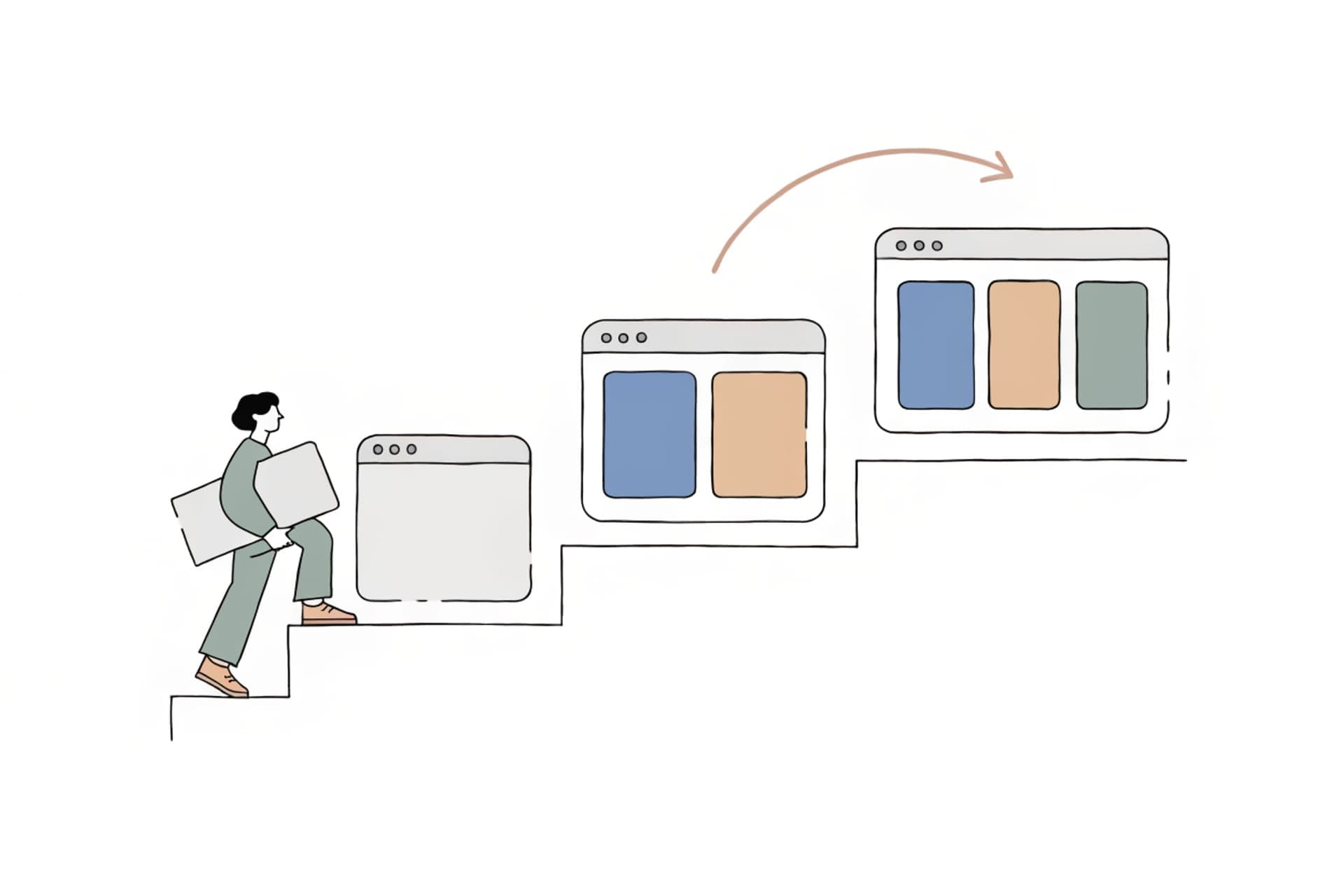
Many business owners build a website, put it online and barely look at it again. The website is up, looks fine and contains the key information. The project seems done. But a website is not a static end product.
Your business changes. Your offer is sharpened. Customers ask different questions. Competitors improve their websites. Google looks differently at content, speed and usability. And visitors expect clarity faster and faster.
If your website does not keep up, it can slowly start to perform less well. Not because it was built badly, but because it no longer fully matches your business, your audience and the way people search.
That is why it is wise to keep improving your website regularly.
Why a website often stands still after launch
In practice it happens often: a website gets a lot of attention at launch. Texts are written, images are placed, pages are set up and everything is checked.
After going live, attention shifts back to daily work. The website stays the way it was.
That is understandable, but not ideal. Because in the meantime all kinds of things are changing:
- your services or products are adjusted
- your audience becomes more specific
- you receive new customer questions
- your competitors publish new content
- old texts no longer fit as well
- new search terms become relevant
- pages can become technically or substantively outdated
- visitor behaviour changes
A website that fitted well two years ago can now no longer be sharp enough.
Improving your website starts with the question: what should the website deliver?
Before you simply adjust texts or publish new blogs, it is important to go back to the goal of your website.
Do you want:
- more quote requests?
- more phone calls?
- more local visibility?
- more trust from visitors?
- better explanation of your services?
- more visitors from Google?
- fewer drop-offs on important pages?
The answer determines which improvements are useful.
Writing a blog can be useful, but not if your services page is unclear. A new call-to-action can help, but not if your offer is not explained clearly. And SEO optimisation has little effect if your website is technically slow or messy.
That is why website optimisation works best when you look in a focused way at technology, content, visibility and conversion.
1. Improve your most important pages first
Many business owners immediately think of new content when it comes to improving a website. But often the biggest gains are in existing pages.
These pages are particularly important:
- homepage
- service pages
- contact page
- about us page
- project or case pages
- frequently asked questions
- key landing pages
These pages often get the most visitors or play an important role in the decision to make contact.
Look critically at questions such as:
- is it immediately clear what you offer?
- do you address the right audience?
- is the most important content at the top?
- are the benefits concrete enough?
- does the page contain proof, such as cases or examples?
- is there a clear call-to-action?
- does the text match search terms your audience uses?
Improving an existing page can sometimes deliver more than publishing a new blog.
2. Sharpen your offer
A website does not grow with you if your offer on the site stays outdated or too general.
Many companies develop further. You get better clients, different projects, more experience or a clearer specialisation. But the website still shows a broad text written years ago.
Then a gap arises between what your business is now and what your website communicates.
So pay attention to:
- are your services still up to date?
- do you clearly state who you work for?
- are old or less interesting services still too prominent?
- are new services or packages missing?
- do you explain well what sets you apart?
- does your tone of voice match your ideal client?
A sharp website helps visitors decide more quickly whether you are the right partner.
3. Work on better visibility
If your website gets few relevant visitors, website optimisation is also an SEO issue.
SEO does not only start with blogs. Often you can already improve existing pages by better matching search intent.
Think about:
- clear page titles
- good meta descriptions
- logical H1s and H2s
- placing search terms in natural spots
- adding internal links
- answering frequently asked questions
- using local search terms
- updating old content
- structuring pages better
A service page about "website maintenance" should not only explain what maintenance is, but also answer questions potential customers have. What is included? Why is it needed? What happens if you do not do it? What does it cost roughly? Who is it suitable for?
This way you make pages more relevant for visitors and easier to understand for search engines.

4. Add content that answers real customer questions
New content can be valuable, but only if it matches concrete questions from your audience.
Not every blog delivers something. A blog without search intent or a clear link to your offer may add some extra content, but not automatically better leads.
Good content helps visitors with a decision.
Examples of valuable topics are:
- when should I renew my website?
- what does a professional website cost?
- why is website maintenance needed?
- how do I improve my visibility?
- why does my website not generate requests?
- what is the difference between WordPress and custom?
- how do I make my website faster?
- how do I know if my website is still good enough?
This kind of content attracts visitors who are already thinking about a problem your solution addresses.
5. Improve the call-to-actions
A website can be good in terms of content, yet still deliver few requests if the next step is not clear.
Visitors should not have to search for what they can do. Every important page needs a clear call-to-action.
Examples:
- Request advice with no obligation
- Schedule an introduction
- Have your website reviewed
- View our approach
- Request a quote
- Discuss your project
Also pay attention to placement. A button all the way at the bottom is often not enough. Place call-to-actions at logical moments:
- at the top of the page
- after explaining the problem
- after the benefits
- with packages or services
- at the bottom of the page
A good CTA does not feel pushy, but helps the visitor move forward.

6. Look at trust and proof
People do not just make contact. Certainly not when it concerns a service for which they do not know in advance exactly what they will get.
That is why your website must build trust.
You can do that with:
- cases
- project examples
- customer reviews
- a clear way of working
- recognisable contact information
- explanation of who is behind the company
- concrete benefits
- clear agreements
- realistic language without overblown promises
A website without proof quickly stays generic. Visitors want to see that you have experience and understand what they need.
7. Check the mobile experience
Many visitors view your website on their phone. Yet websites are often mainly judged on desktop during development or maintenance.
That is why it is wise to check on mobile regularly:
- are texts readable?
- are buttons easy to tap?
- is the menu clear?
- do forms work pleasantly?
- do pages load quickly?
- does the order of content stay logical?
- is the contact button quick to find?
A website that is strong on desktop can still lose visitors on mobile.
8. Keep technology and speed in order
Technology plays a big role in how well your website performs.
A slow or technically outdated website can cause drop-offs. Error messages, heavy images or unnecessary scripts can also worsen the user experience.
Pay attention to elements such as:
- loading time
- image optimisation
- caching
- plug-ins or external scripts
- error messages
- indexability
- form behaviour
- security
- hosting
- mobile performance
Technical optimisation is not always visible to visitors, but the effect often is: a website feels faster, more stable and more professional.
9. Use data to make better choices
Improving a website does not have to be done on gut feeling.
With data from Google Search Console or Analytics, for example, you can better determine where the opportunities lie.
Among other things, you can look at:
- which pages attract visitors
- which search terms you are already visible for
- which pages get many impressions but few clicks
- which pages get little traffic
- where visitors drop off
- which content is outdated
- which search questions are not yet well answered
This prevents you from optimising at random. You choose more deliberately which page, text or call-to-action deserves attention.

10. Make improving your website a routine process
The biggest mistake is to think that your website needs to be fully renewed once every few years and needs nothing in between.
It is often smarter to make small improvements monthly or quarterly.
Think of:
- improving an existing page
- expanding an FAQ
- writing a blog around a concrete search question
- adding internal links
- optimising metadata
- improving a CTA
- adding a case
- updating old content
- checking speed
- testing forms
This way your website stays current and you avoid having to start from scratch again in a few years.
Want to get structurally more out of your website? With Beheer, Onderhoud & Groei we improve your website monthly on technology, SEO, content and conversion.
Examples of monthly website improvements
To make it concrete: website improvement does not have to be big or complicated.
Examples of practical improvements are:
- rewriting a service page based on search intent
- adding a clear CTA to an important page
- expanding frequently asked questions
- writing a blog article about a customer question
- improving internal links
- sharpening meta title and meta description
- updating old content
- making a contact block clearer
- optimising images
- adding a case or project
- using local search terms
- improving mobile buttons
It is not about as many changes as possible, but about the right improvements at the right time.
When is a new website needed?
Sometimes optimising is enough. But sometimes a website is so outdated that improving delivers little.
A new website can be wiser if:
- the technical foundation is heavily outdated
- the website stays slow despite optimisation
- the design no longer comes across as professional
- the structure no longer matches your offer
- the website works poorly on mobile
- there are too many technical limitations
- your positioning has changed completely
- your current website is hard to manage
In other cases, further development is actually smarter. Then you keep what is good and improve step by step.
Beheer, Onderhoud & Groei: for websites that cannot stand still
For business owners who use their website seriously, just being online is not enough.
A website must remain technically healthy, but also grow with your business. That is why it makes sense to combine maintenance with periodic optimisation.
With Beheer, Onderhoud & Groei you work monthly on improvements such as:
- technical checks
- SEO optimisation
- content improvement
- internal links
- FAQs
- better call-to-actions
- improving existing pages
- a short report of completed actions
This way your website not only stays safe and current, but also gets stronger step by step.
Conclusion: your website is never really finished
A website is not finished the moment it goes live. Your website must keep matching your business, your audience and the way people search.
By regularly working on technology, content, SEO and conversion your website stays current, reliable and more effective.
You do not need to make big changes every month. Often it is precisely small, targeted improvements that keep your website performing better.
Do you want your website not to stand still, but to keep growing with your business? Then monthly optimisation is a smart step.
Frequently asked questions
Why must you keep improving a website?
A website must keep matching your offer, audience and customer search behaviour. By improving regularly your website stays current, clear, technically healthy and better focused on generating requests.
What can you improve on an existing website?
You can improve, among other things, texts, call-to-actions, SEO titles, meta descriptions, internal links, speed, mobile user experience, forms, FAQs and existing service pages.
Is a new website always needed?
No, not always. Sometimes targeted improvements to existing pages, technology, SEO and conversion can already achieve a lot. A new website mainly makes sense when the technical foundation or structure is heavily outdated.
How often should you optimise a website?
For many business websites monthly or quarterly optimisation is sensible. This way you can carry out small improvements regularly and prevent the website from ageing over time.
Does website optimisation help with more requests?
Yes, targeted website optimisation can help to generate more requests. Think of clearer texts, better call-to-actions, stronger service pages, faster loading times and better alignment with search terms.
Want to keep improving your website? With Beheer, Onderhoud & Groei we keep your website technically healthy and work monthly on targeted improvements in SEO, content and conversion. This way your website not only stays online, but grows step by step with your business.